How To Write Self Checking Testbench In Verilog. The testbench provides clock, up/down, enable and reset control signals. Feed the squared value to your square root algorithm and then verify that the original randomly chosen binary value pops out.
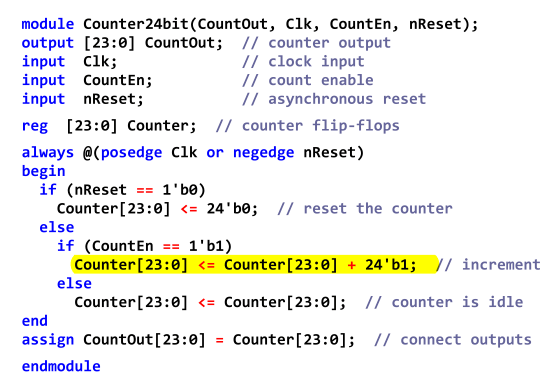
verilog Increment operation in 24 bit counter Electrical from electronics.stackexchange.com
We start by looking at the architecture of a verilog testbench before considering some key concepts in verilog testbench design. When using vhdl to design digital circuits, we normally also create a testbench to stimulate. Modern generators generate random, biased.
End Always #10 Clk = ~Clk;
Student has a coded a full adder module. It is a container where the design is placed and driven with different input stimulus. Input block consist of stimulus and driver to drive the stimulus to dut.
Often To Test The Functionality The Tb Needs The Equivalent Code Of The Dut To Generate The Expected Outcome.
This post describes how to write a verilog testbench for bidirectional or inout ports basic verilog testbench help. A self checking testbench is a intelligent testbench which does some form of output sampling of dut and compares the sampled output with the expected outputs. So far examples provided in ece126 and.
Still Purely System Verilog Though, No Uvm.
This is in contrast to the designer looking at the waveforms and declaring that 'it all works'. The various functions on the left side of the diagram provide. Verilog is a hardware description language (hdl) used to mod.
You Should Add Assertions To Do The Protocol Checks.
Modern generators generate random, biased. A powerful feature for design verification projects Carnegie mellon 12 testbench with testvectors the more elaborate testbench write testvector file:
In Order To Build A Self Checking Test Bench, You Need To Know What Goes Into A Good Testbench.
Considering design complexity, we may have. The output block consists of monitor to collect the dut outputs and verify them. Initial begin clk = 0;