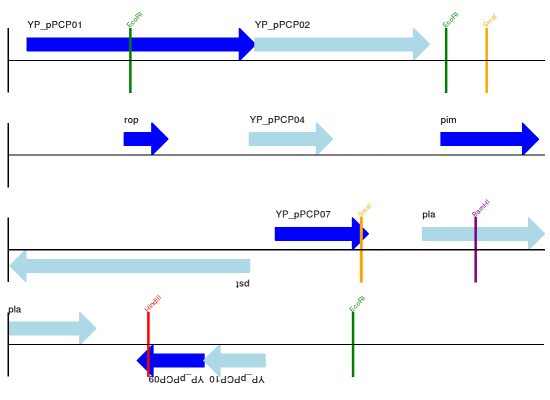
How To Write Plasmid Name. One common result is the sticky ends from the same plasmid molecule coming together. A plasmid is a small, extrachromosomal dna molecule within a cell that is physically separated from chromosomal dna and can replicate independently.
Chapter 17 Graphics including GenomeDiagram — Biopythoncn 0.1 文档 from biopython-cn.readthedocs.io
When you are seen a plasmid at addgene (i don't know if it is the same for other repositories), click view all sequences. It is widely used now as a cloning vector to deliver desirable genes to the host plant to get transgenic plants. Before you start working with any plasmid, it is advisable to linearize it by cutting.
Bacteriocins Often Kill Cells By Creating Channels In The Plasma Membrane Thus Increasing Its Permeability.
Explain who you are, where you found out about the plasmid, and if possible. As you see from the map center, the size of the linearized plasmid is 4361 base pairs. The basic rule for writing a scientific name use both genus and species name:
Indicate The Name Of The Plasmid, The Plasmid Origin, And.
A promoter region is the part of plasmids responsible for recruiting the transcriptional machinery. There you will see many graphics with the whole. Yes, if a scientist publishes a plasmid, there is an obligation to distribute it, but remember who put in the work to make the reagent.
This Will Give The Same Plasmid Sequence As The Original And Is Called The Nonrecombinant Plasmid.
They typically have a small number of genes — notably, some associated with antibiotic resistance — and can be passed from one cell to another. This simple piece of information can often convey many important details. A plasmid map is the relative positions of the elements within the plasmid.
Plasmids Are Either Low, Medium Or High Copy Number.
One common result is the sticky ends from the same plasmid molecule coming together. They are the name and the size of the plasmid, the elements of the plasmid, their relative positions, and the orientation of the promoter. Include the empty backbone name in your plasmid name.
Produce Large Amounts Of A Protein So That Scientists Can Purify And Study It In A Controlled Setting.
It kills other host cells by producing toxic proteins and also protects its own cells by developing resistance or killing the foreign organism. Some of the other components of plasmids include. Cole1 rna i and rna ii).